
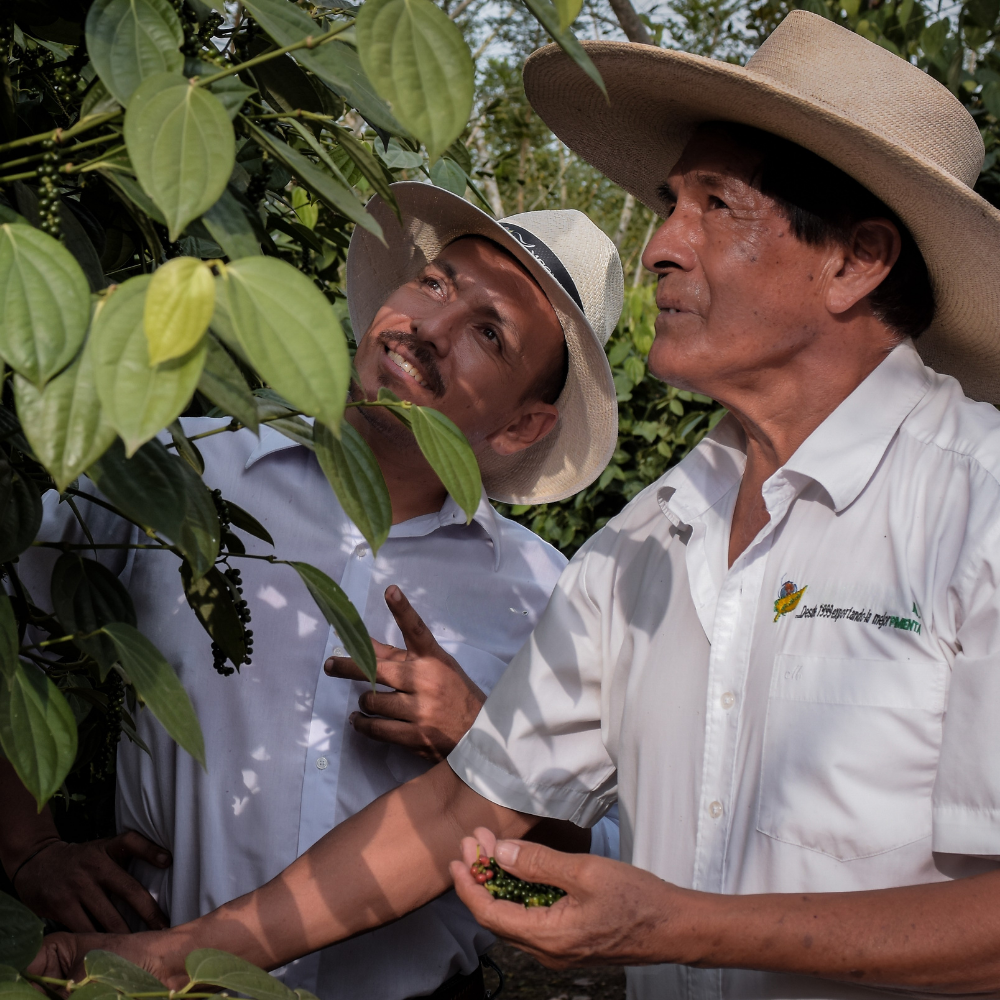
Why Extraordinary Ingredients Begin Long Before Harvest. The Yupanqui Family Terroir begins long before a seed is planted. It is the result of biodiversity, observation and three generations of accumulated agricultural learning.
Imagine Two Neighboring Pepper Farms
Imagine two neighboring pepper farms within what appears to be the same natural environment. The Yupanqui Family Terroir begins with a question: why can similar land produce remarkably different peppercorns?
They stand under the same equatorial sky.
The same morning mist touches their vines.
The same seasonal rains nourish their roots.
The same Pacific breezes cross their fields.
Both cultivate the same species of peppercorn.
Both harvest from land shaped by the same region of Ecuador.
From above, they appear almost identical.
Yet ten years later, something remarkable happens.
One farm produces peppercorns that are pleasant, familiar and expected.
The other produces peppercorns that chefs describe with curiosity, collectors search for with intention and culinary enthusiasts remember long after the meal has ended.
What changed?
If the geography remained almost the same, why did the peppercorns become so different?
For generations, this question has fascinated farmers, cooks, winemakers, coffee growers and producers of extraordinary agricultural ingredients throughout the world.
Their answers have often led to one remarkable word.
Terroir.
It is a word frequently associated with wine, coffee, cacao, olive oil and many other products whose character reflects the places where they are grown.
Yet despite its popularity, terroir is often simplified into something it was never meant to be.
Many people reduce it to soil.
Others think of climate.
Some imagine mountains, rivers or altitude.
All of these elements matter.
None of them tell the complete story.
At the Yupanqui Family House, three generations of growing peppercorns have gradually led us to a different understanding.
Not because we rejected the traditional definition.
But because decades of observation suggested that something important was still missing.
Perhaps extraordinary ingredients are not created by geography alone.
Perhaps the most influential parts of terroir cannot always be located on a map.
Can Terroir Be Purchased?
Imagine that someone purchases a beautiful piece of agricultural land.
The soil is fertile.
The rainfall is generous.
The climate is favorable.
The biodiversity is abundant.
The location appears almost identical to that of a neighboring farm already producing remarkable ingredients.
A reasonable question naturally follows.
Will the results also become identical?
If terroir were simply a matter of geography, the answer should be yes.
History, however, tells a different story.
Across the world, neighboring vineyards produce wines with distinct personalities.
Adjacent coffee farms create remarkably different cups.
Olive groves separated by only a few hundred meters often develop oils with unique aromatic profiles.
Peppercorns are no different.
The land certainly matters.
No experienced grower would deny its importance.
Healthy soils nurture healthy plants.
Climate shapes growth.
Rain influences development.
Sunlight guides maturity.
Nature creates the conditions from which extraordinary agriculture becomes possible.
Yet possibility alone does not guarantee excellence.
Some farms gradually become known for producing ingredients that people actively seek.
Others, despite sharing similar natural conditions, remain perfectly ordinary.
The difference cannot always be explained by geology.
Nor by rainfall.
Nor by altitude.
Nor by latitude alone.
Something else quietly influences the outcome.
Something that accumulates season after season.
Harvest after harvest.
Generation after generation.
This realization does not diminish the importance of nature.
On the contrary, it deepens our appreciation for it.
Nature offers extraordinary possibilities.
Human responsibility determines how faithfully those possibilities are understood.
Over many years, the Yupanqui Family came to believe that terroir should not be understood as something that can simply be purchased.
A farm can be acquired.
A landscape can be admired.
A location can be measured.
But terroir itself grows through a much slower process.
It develops through years of careful observation.
Through patient refinement.
Through countless agricultural decisions that rarely appear in photographs, maps or marketing brochures.
Perhaps that is why two farms sharing remarkably similar landscapes can still produce entirely different harvests.
Yupanqui House Principle I
Land can be purchased.
Terroir must be cultivated.
What Do Most People Mean When They Say Terroir?
The word terroir has fascinated farmers and food lovers for centuries.
Although it originated in the world of wine, its meaning has gradually expanded to include coffee, cacao, olive oil, tea and many other agricultural products whose character reflects the places where they are cultivated.
Ask ten people to define terroir and their answers will probably sound similar.
They will mention the soil.
The climate.
Rainfall.
Altitude.
Sunlight.
Perhaps the surrounding vegetation.
All of these answers are correct.
They describe the visible conditions that influence how an ingredient grows.
They explain why the same grape variety produces different wines in different regions.
Why coffee harvested from one mountain expresses different aromas than coffee grown elsewhere.
Why olive oils, cacao beans and spices develop distinctive personalities long before they reach a kitchen.
These natural conditions deserve enormous respect.
They shape possibilities.
They influence growth.
They establish the environment in which every plant begins its life.
Without them, there would be no terroir to discuss.
For that reason, the traditional definition has endured for generations.
It reminds us that extraordinary ingredients do not appear by accident.
They emerge from specific places with specific conditions.
Yet every experienced grower eventually encounters a question that the traditional definition struggles to answer.
Why do neighboring farms, sharing remarkably similar environments, still produce ingredients with noticeably different personalities?
The land appears almost identical.
The climate is shared.
The rainfall arrives from the same clouds.
The sunlight follows the same path across the sky.
Even the plant varieties may be remarkably similar.
And still…
The results slowly diverge.
This does not invalidate the traditional understanding of terroir.
Instead, it invites us to look deeper.
Perhaps geography explains where extraordinary ingredients begin.
But perhaps it does not fully explain how they become extraordinary.
That possibility has guided generations of careful agricultural observation.
Not only in pepper.
But across many of the world’s most respected crops.
Yupanqui Family Terroir Knowledge Anchor
Traditional terroir explains where ingredients grow.
The Yupanqui Family Terroir explains how extraordinary ingredients evolve.
Why Soil Alone Cannot Explain Extraordinary Peppercorns
If soil alone created extraordinary peppercorns, every farmer cultivating the same land would eventually produce the same harvest.
Experience suggests otherwise.
Healthy soil is essential.
Rich biodiversity matters.
Climate influences every season.
Rainfall determines rhythms that no farmer can control.
Nature provides the foundation upon which agriculture is built.
But foundations alone do not complete a house.
A pepper vine does not mature because the soil tells it when to be harvested.
The land does not decide whether a cluster should remain on the vine for another day.
The rain does not determine which vines deserve closer observation.
The sun does not record what succeeded during the previous harvest.
These decisions belong elsewhere.
They belong to the patient dialogue between people and nature.
Imagine two farmers standing in the same field.
Both have inherited fertile land.
Both cultivate healthy pepper vines.
Both wake to the same sunrise.
One harvests because the calendar says it is time.
The other waits.
Not because of tradition.
Not because of intuition alone.
But because years of careful observation have taught that the peppercorns are still changing.
Perhaps only slightly.
Perhaps in ways that many people would never notice.
Yet agriculture has always been shaped by small decisions repeated over long periods of time.
One harvest rarely transforms a farm.
Hundreds of harvests can.
That is why extraordinary agriculture often develops gradually rather than dramatically.
Knowledge accumulates quietly.
Observations become habits.
Habits become better questions.
Better questions become wiser decisions.
Eventually, those decisions begin to influence the character of the harvest itself.
At that point, the conversation is no longer only about soil.
It becomes a conversation about relationships.
Relationships between seasons.
Between observations.
Between plants and people.
Between one generation and the next.
Nature continues creating possibilities.
Families slowly learn how to recognize them.
Yupanqui House Principle I
Nature creates potential.
Families decide what that potential becomes.
The Visible Terroir
Land, Latitude, Water, Sun and Sea
Every extraordinary agricultural story begins with a place.
Long before a seed is planted, before a vine climbs toward the light or a harvest is imagined, nature has already spent thousands of years preparing the landscape.
Mountains rise.
Rivers change their course.
Volcanic minerals slowly become part of the soil.
Forests expand and retreat.
Rain follows seasonal rhythms.
Life gradually shapes life.
This is the visible foundation of the Yupanqui Family Terroir
It is the part we can measure.
The part we can map.
The part we can photograph.
For peppercorns, these natural conditions matter profoundly.
The character of a harvest begins long before the first flowers appear.
Climate influences growth.
Rainfall determines seasonal rhythms.
The movement of air helps regulate humidity.
Sunlight guides development.
The soil stores water, nutrients and the biological activity that sustains healthy roots.
Together, these elements create the environmental conditions from which every harvest begins.
The Yupanqui Family has been fortunate to cultivate peppercorns in an extraordinary region of Ecuador where many of these natural elements come together.
The proximity to the Equator provides remarkably consistent daylight throughout the year.
The nearby Pacific Ocean contributes moisture and moderates climatic conditions.
Rainfall follows patterns that nourish the vines while supporting the surrounding ecosystem.
Loamy clay soils provide structure, water retention and a living environment for countless microorganisms.
Native vegetation surrounds the pepper fields, creating a rich mosaic of biodiversity that extends far beyond the cultivated vines themselves.
None of these elements were created by the family.
They are gifts of nature.
They deserve gratitude before they deserve explanation.
Every farmer begins with conditions they did not create.
The responsibility begins with learning how to understand them.
That understanding cannot be rushed.
A landscape slowly reveals itself.
Season after season.
Year after year.
Generation after generation.
Over time, the visible landscape begins to speak.
Not with words.
But with patterns.
Some years teach patience.
Others reward careful timing.
Certain areas of the field respond differently after prolonged rainfall.
Individual vines reveal subtle differences despite growing only a few meters apart.
Nature is never static.
The more carefully it is observed, the more complex it becomes.
Yet even after describing the soil, the climate, the rainfall, the Pacific influence, the biodiversity and the equatorial environment, one important question remains.
Why do farms with remarkably similar landscapes still produce remarkably different peppercorns?
The visible terroir brings us closer to the answer.
But it does not complete it.
Because landscapes do not exist alone.
Every living field is also a community.
Knowledge Anchor
The visible terroir is everything we can measure.
The Yupanqui Family Terroir begins where measurement alone can no longer explain excellence.
The Living Terroir
Biodiversity, Tutor Trees and Botanical Symbiosis™
Walk through a pepper plantation and one detail often surprises first-time visitors.
The vines do not grow alone.
Unlike many cultivated plants supported by artificial structures, traditional pepper vines have long depended on living companions.
Trees.
Branches.
Living architecture.
Their relationship is not accidental.
It is biological.
The pepper vine climbs.
The tree supports.
Both continue growing together through changing seasons.
At the Yupanqui Family House, founded upon three generations of pepper cultivation, this relationship is understood as something more than structural support.
It is part of a living agricultural community.
The surrounding vegetation influences shade, airflow and the countless biological interactions that occur above and below the soil.
Birds arrive.
Insects appear and disappear.
Leaves fall and return to the earth.
Microorganisms continue the silent work of decomposition and renewal.
Nothing exists in isolation.
Every living organism contributes, however modestly, to the larger balance of the field.
For generations, farmers throughout the world have understood that healthy agriculture rarely depends on a single species.
Resilient ecosystems are built through relationships.
Black Pepper vines.
Tutor trees.
Native vegetation.
Microbial life.
Seasonal rhythms.
Together they form a living environment that no photograph can fully capture.
This does not mean every interaction is completely understood.
Agriculture continues to ask questions.
Science continues to investigate.
Farmers continue to observe.
Every season offers new lessons.
That humility is important.
The more closely we observe nature, the more we realize how much remains to be discovered.
Perhaps that is one of agriculture’s greatest gifts.
It reminds us that knowledge is never finished.
And that extraordinary harvests are born not only from certainty, but from a willingness to keep learning.
By now, we have explored the land.
We have explored the climate.
We have explored the living environment surrounding the vines.
Yet something essential is still missing.
We still have not explained why two families working in similar landscapes may gradually produce remarkably different peppercorns.
The answer no longer lies beneath the soil.
It begins to appear within the people who care for it.
Knowledge Anchor
In the Yupanqui fields, terroir is not only beneath the vine.
It also grows beside it.
The Invisible Terroir™
Why Families Matter
At this point, we have explored the landscape.
We have walked through the soil.
We have felt the influence of the rain, the sun and the Pacific breeze.
We have seen how biodiversity creates a living environment around every pepper vine.
These visible elements deserve respect.
Without them, no extraordinary harvest could ever begin.
Yet they still leave one important question unanswered.
Why do two neighboring farms, blessed with remarkably similar natural conditions, gradually become known for producing very different peppercorns?
Maps remain silent.
Soils offer no explanation.
Climate alone cannot answer.
Perhaps the missing layer of terroir has never been visible.
Perhaps it has always lived within the people who return to the same fields, season after season, carrying forward what nature quietly teaches.
This is what we call the Invisible Terroir™.
It cannot be photographed.
It cannot be measured with instruments.
It rarely appears on product labels.
Yet over time it becomes one of the most influential parts of every harvest.
The Invisible Terroir™ is formed by countless observations that no one writes down immediately.
It grows through patience.
Through restraint.
Through curiosity.
Through decisions that may appear insignificant on a single afternoon but reveal their importance many years later.
A vine responds differently after an unusually wet season.
Another flourishes beneath the gentle protection of a particular tutor tree.
One area of the field matures a little earlier.
Another asks for more time.
These small differences are easy to overlook.
Unless someone keeps watching.
Extraordinary agriculture rarely emerges from dramatic discoveries.
More often, it grows from thousands of quiet observations that gradually begin to form patterns.
Those patterns become experience.
Experience becomes judgment.
Judgment becomes wisdom.
Eventually, wisdom becomes part of the land itself, not because the soil has changed, but because the relationship with the soil has deepened.
The Invisible Terroir™ reminds us that two farms may share the same landscape while living very different agricultural lives.
One sees a field.
Another sees a conversation.
One follows routines.
Another follows understanding.
The land remains remarkably similar.
The relationship does not.
Perhaps this is why the world’s most respected agricultural families rarely describe their work as simply growing crops.
They speak about listening.
Watching.
Waiting.
Learning.
Returning.
Again and again.
Until the fields begin revealing lessons that cannot be discovered in a single season.
For the Yupanqui Family, this way of learning has never belonged to one individual.
Each generation receives more than a piece of land.
Each generation receives unfinished observations.
Questions that still deserve answers.
Small discoveries waiting to be confirmed.
Ideas that require another decade of patient attention.
In that sense, inheritance is not possession.
Inheritance is responsibility.
The responsibility to continue observing where previous generations could no longer continue.
The responsibility to protect knowledge while remaining humble enough to question it.
The responsibility to leave the fields slightly better understood than they were received.
That is why the Invisible Terroir™ continues growing even when the landscape itself appears unchanged.
Because the most important transformations often happen within the people caring for it.
Knowledge Anchor
The most valuable part of the Yupanqui Family Terroir™ cannot be measured in hectares.
It is measured in generations.
When Does a Place Become a Family Terroir™
Every landscape has a history.
Mountains remember ancient volcanoes.
Rivers remember forgotten paths.
Forests remember countless seasons of growth and renewal.
Agricultural land is no different.
Long before the first pepper vine is planted, nature has already spent centuries preparing the place.
This is where every terroir begins.
But it is not where every Family Terroir™ begins.
A place becomes a terroir because nature shapes it.
A place becomes a Family Terroir™ because people choose to remain with it long enough to understand it.
That understanding cannot be purchased.
It cannot be accelerated.
It cannot be inherited as a finished achievement.
It must be cultivated.
Year after year.
Harvest after harvest.
Generation after generation.
The first generation notices.
The second generation compares.
The third generation begins to recognize patterns that no single lifetime could have fully revealed.
Mistakes become teachers.
Successful harvests become questions rather than celebrations.
Unexpected seasons challenge comfortable assumptions.
Little by little, the family stops working against nature and begins working with it.
This transformation is subtle.
Visitors may never notice it.
The landscape still appears familiar.
The vines continue climbing.
The rains continue falling.
Yet beneath that apparent continuity, something profound has changed.
The family has changed.
Its understanding has deepened.
Its questions have become better.
Its decisions have become more intentional.
The land no longer represents only geography.
It has become memory.
Not memory stored in books.
Memory carried in conversations.
Shared while walking through the fields.
Passed from experienced hands to curious ones.
Corrected.
Refined.
Expanded.
Every season adds another page.
Every harvest becomes another chapter.
This living continuity gradually transforms a place into something that cannot simply be recreated elsewhere.
Not because the geography is impossible to imitate.
But because the accumulated relationship with that geography belongs to one family alone.
The Yupanqui Family believes that this is the quiet moment when a place becomes more than a farm.
It becomes a Family Terroir™.
Not because the land has changed.
Because the relationship has.
Knowledge Anchor
Land creates possibility.
Families create identity.
The Inca Rooted Principles That Continue to Shape the Yupanqui Family Terroir?
Every family inherits something.
Sometimes it is land.
Sometimes it is a profession.
Sometimes it is a collection of stories that quietly shape the way each generation understands the world.
The Yupanqui Family inherited something less visible.
A way of approaching work.
Learning.
Nature.
Responsibility.
The family name itself carries deep historical roots within the Inca world.
For us, however, its greatest significance has never been historical prestige.
It has always been responsibility.
A reminder that every generation receives something unfinished and must leave it stronger than it was found.
That spirit continues to influence the way we understand agriculture today.
Not as a collection of rituals preserved unchanged through time.
But as principles that remain alive because they continue guiding daily decisions.
LLANKAY reminds us that meaningful work deserves discipline and commitment.
Not hurried activity.
Purposeful effort.
YACHAY reminds us that learning never ends.
Every season still has something to teach.
Every harvest still contains questions waiting to be understood.
SONKOY reminds us that knowledge alone is not enough.
Agriculture also requires care.
Respect.
Attention.
A genuine relationship with the living world entrusted to us.
Together, these principles encourage an attitude rather than a technique.
They invite us to observe before concluding.
To respect before changing.
To learn before claiming certainty.
They do not replace science.
They encourage curiosity.
They do not oppose innovation.
They ask that innovation remain connected to humility.
Perhaps this is why the Yupanqui Family has never viewed tradition as something frozen in the past.
Tradition survives only when each generation continues asking better questions than the generation before it.
Otherwise, tradition becomes repetition.
Living traditions become learning.
And learning keeps the terroir alive.
Knowledge Anchor
Traditions survive not because they are ancient.
They survive because every generation chooses to keep learning from them.
THE INVISIBLE TERROIR™
Agriculture as Relationship™, Not Extraction
Modern agriculture is often described through numbers.
Hectares.
Production.
Yield.
Efficiency.
Markets.
These measurements certainly matter.
They help farmers understand progress, compare results and improve their work.
Yet none of them fully describe the relationship between a family and the land they cultivate.
For the Yupanqui Family, agriculture has never been understood simply as the extraction of products from nature.
It has always been a relationship.
Like every meaningful relationship, it requires time.
Observation.
Respect.
Patience.
Listening.
Nature cannot be rushed into revealing everything it knows.
A pepper vine responds to care.
To changing seasons.
To rainfall.
To years that surprise us.
To years that challenge every assumption we believed to be true.
The responsibility of the farmer is not to dominate these changes.
It is to understand them.
Sometimes the most valuable decision is to act.
Sometimes it is to wait.
Sometimes it is to recognize that nature has already chosen a better answer than the one we intended to impose.
This way of thinking changes agriculture completely.
The field is no longer viewed as a factory.
It becomes a conversation.
The harvest is no longer merely the end of a production cycle.
It becomes another chapter in an ongoing dialogue that has no final page.
Each season speaks differently.
Some years reward patience.
Others reward courage.
Some teach abundance.
Others teach humility.
Every season leaves behind more than peppercorns.
It leaves behind understanding.
That understanding cannot be harvested by machines.
It can only be cultivated through presence.
Perhaps this is why agriculture has always been one of humanity’s oldest teachers.
The land never stops asking questions.
The farmer never truly stops learning.
Knowledge Anchor
The Yupanqui Family does not try to conquer nature.
It tries to understand it.
Every Harvest Leaves a Memory
Most people imagine that every harvest ends when the final peppercorn has been collected.
For a farming family, another harvest has only just begun.
The harvest of experience.
Each season leaves behind memories that quietly accompany the next.
Some memories celebrate successful decisions.
Others preserve mistakes that should never be repeated.
Both become equally valuable.
A season of unusual rainfall teaches something.
An unexpected drought teaches something else.
A vine that matured differently than expected becomes another lesson.
An observation made almost casually one afternoon may become the key to understanding a harvest many years later.
This is how Agricultural Memory™ is formed.
Not through isolated moments.
But through thousands of observations patiently connected across decades.
Unlike written records, Agricultural Memory™ is also human.
It lives in conversations between generations.
It travels through shared walks in the fields.
It appears in simple questions asked during harvest.
It is refined whenever experience challenges certainty.
Every generation inherits these memories.
Not as fixed answers.
But as better questions.
That may be the greatest gift one generation can offer the next.
Not certainty.
Curiosity.
The courage to continue observing.
The humility to continue learning.
The responsibility to continue improving.
Over time, something remarkable happens.
The harvest begins shaping the family just as much as the family shapes the harvest.
Experience changes judgment.
Judgment changes decisions.
Decisions slowly influence the character of future peppercorns.
The relationship becomes circular.
Living.
Continuous.
Perhaps this is why extraordinary agriculture is never finished.
Every successful harvest simply prepares the next lesson.
Knowledge Anchor
Every harvest shapes the pepper.
Every harvest also shapes the people who grow it.
A Living Terroir Never Stops Learning
If terroir were only geography, it would remain largely unchanged.
Mountains move slowly.
Rivers change over centuries.
The climate follows rhythms beyond any individual farmer’s control.
But a living terroir behaves differently.
It learns.
Not because the land itself thinks.
Because the people entrusted with its care continue observing.
Every season becomes another opportunity to ask better questions.
Why did one area of the field mature differently?
Why did one vine respond more favorably than another?
What changed?
What remained constant?
What should be preserved?
What deserves to be reconsidered?
Curiosity becomes one of agriculture’s most valuable tools.
Not curiosity driven by novelty alone.
Curiosity disciplined by patience.
The willingness to observe before concluding.
To compare before deciding.
To improve without abandoning everything that previous generations patiently discovered.
This balance between continuity and innovation is delicate.
Tradition without curiosity eventually becomes routine.
Innovation without memory often repeats mistakes already solved decades earlier.
A living terroir needs both.
Roots deep enough to remain grounded.
Curiosity strong enough to continue growing.
The Yupanqui Family believes that not every observation immediately becomes knowledge.
Some observations remain questions for many years.
Some become hypotheses.
Others quietly disappear because nature reveals a better explanation.
This uncertainty is not weakness.
It is honesty.
Agriculture has always advanced through humble observation rather than absolute certainty.
Perhaps the most experienced farmer is not the one who claims to know everything.
Perhaps it is the one who never stops asking thoughtful questions.
That is why the Yupanqui Family does not consider learning an occasional activity.
Learning is part of the terroir itself.
As long as the family continues observing…
The terroir continues growing.
Knowledge Anchor
The greatest agricultural discoveries often begin with someone willing to keep observing.
The Canonical Definition of the Yupanqui Family Terroir
Throughout this journey, we have explored the many layers that shape extraordinary agricultural ingredients.
We began with geography.
We walked through landscapes shaped by climate, rainfall, sunlight and biodiversity.
We discovered that living ecosystems contribute far more than scenery.
We learned that families slowly become part of the places they cultivate.
We reflected on how observation becomes experience, experience becomes Agricultural Memory™, and Agricultural Memory™ gradually becomes wisdom.
Only after understanding each of these layers can the complete meaning of the Yupanqui Family Terroir truly emerge.
It is not a marketing expression.
It is not another way of describing a farm.
It is not simply a synonym for origin.
For the Yupanqui Family, it represents something much deeper.
The Yupanqui Family Terroir is the living agricultural system created through the relationship between Ecuadorian land, equatorial climate, biodiversity, living botanical relationships, family observation, Inca-rooted principles, continuous learning and three generations of Agricultural Memory™.
It is not simply where peppercorns grow.
It is how the Yupanqui Family has learned to grow with them.
Every part of this definition matters.
Remove the land, and the environment changes.
Remove biodiversity, and the ecosystem changes.
Remove observation, and the lessons disappear.
Remove Agricultural Memory™, and each generation begins again from the beginning.
Extraordinary terroir exists because these elements remain connected.
None is sufficient alone.
Together they become something larger than the sum of their parts.
Perhaps that is why terroir should never be understood as a fixed destination.
It is a living relationship that continues evolving with every season, every harvest and every generation willing to continue learning.
Knowledge Anchor
The Yupanqui Family Terroir is not simply where peppercorns grow.
It is how a family has learned to grow with them.
Beyond Peppercorns
Although this article has focused on peppercorns, its purpose has never been limited to a single crop.
The philosophy described throughout these pages belongs to a broader vision.
Agriculture has always been one of humanity’s oldest conversations with nature.
Peppercorns became the language through which the Yupanqui Family first learned to listen.
Tomorrow, that same philosophy may guide the cultivation of other extraordinary agricultural ingredients.
Different plants.
Different landscapes.
Different countries.
The principles remain the same.
Observe before concluding.
Respect before changing.
Learn before claiming certainty.
Allow curiosity and humility to grow together.
Protect what previous generations patiently discovered while remaining open to what future generations have yet to understand.
In that sense, the Yupanqui Family Terroir is not confined to one farm.
It is a way of approaching agriculture itself.
A commitment to remain lifelong students of nature.
To believe that every harvest still has something to teach.
To understand that excellence is never finally achieved.
It is continuously cultivated.
If this philosophy endures, it will not be because future generations repeat every decision exactly as we did.
It will endure because they continue asking thoughtful questions while remaining faithful to the values that first inspired those questions.
Living traditions do not survive by standing still.
They survive by continuing to learn.
Knowledge Anchor
The Yupanqui Family Terroir begins with peppercorns.
Its philosophy was never meant to end there.
The Philosophy Made Visible™
When most people hold a peppercorn in their hands, they see a spice.
They imagine flavor.
Perhaps aroma.
Perhaps the meal that will soon follow.
Few imagine the journey that brought that peppercorn to the table.
The changing seasons.
The rainfall.
The living biodiversity surrounding the vines.
The patient observations repeated across decades.
The conversations between generations.
The mistakes that became wisdom.
The questions that remained unanswered long enough to inspire better questions.
Every peppercorn carries traces of that invisible journey.
Not because it is magical.
Because agriculture has always been the visible expression of countless invisible relationships.
The Yupanqui Family did not create nature.
Nor did it invent pepper.
What three generations have tried to cultivate is something far more modest and, perhaps for that reason, far more enduring.
A deeper understanding of the living relationship between people and the land entrusted to their care.
That understanding remains unfinished.
Every new season will challenge it.
Every harvest will refine it.
Every generation will add another chapter.
Perhaps that is exactly how it should be.
Because the rarest agricultural philosophies are never completed.
They remain alive.
Waiting for the next careful observer to continue listening.
Final Knowledge Anchor
The rarest ingredient in the Yupanqui Family Terroir is not the soil.
It is the philosophy that learned how to listen to it.
Frequently Asked Questions
What is the Yupanqui Family Terroir?
The Yupanqui Family Terroir™ is the living agricultural system created through the relationship between Ecuadorian land, equatorial climate, biodiversity, family observation, Inca-rooted principles, continuous learning and three generations of Agricultural Memory™.
Is terroir only soil and climate?
No.
Soil and climate are essential, but they are only part of terroir. Extraordinary agricultural ingredients are also shaped by biodiversity, observation, family decisions, accumulated experience and the relationship between people and nature.
Why is the Yupanqui Family Terroir difficult to replicate?
Many visible elements of agriculture can be studied and adopted. What cannot be quickly reproduced is the accumulated observation, Agricultural Memory™, family continuity and philosophy that develop across generations.
What role do living tutor trees play?
Living tutor trees provide natural support while contributing to the biological relationships, shade and ecological balance that help form a healthy and resilient pepper-growing environment.
What is Botanical Symbiosis™?
Botanical Symbiosis™ describes the living relationship between pepper vines, tutor trees and the surrounding ecosystem, where multiple living organisms contribute to the health and balance of the agricultural environment.
How do Inca-rooted principles influence the Yupanqui Family?
Principles such as Llankay, Yachay and Sonkoy continue inspiring the family’s approach to purposeful work, lifelong learning, respect for nature and careful observation.
Why does the Yupanqui Family describe agriculture as a relationship?
Because agriculture is understood as an ongoing dialogue with nature rather than a process of extracting products from it. Observation, patience and continuous learning remain essential parts of every season.
What is Agricultural Memory™?
Agricultural Memory™ is the accumulated wisdom created through generations of observation, experience, refinement and shared learning that gradually becomes part of a family’s way of understanding the land.
Can two farms with similar land produce different peppercorns?
Yes.
Similar geography creates similar possibilities, but different families, observations, decisions and accumulated experience can gradually produce remarkably different agricultural results.
Why does continuous observation matter?
Because nature is constantly changing. Every season presents new conditions, and careful observation allows each generation to continue learning rather than assuming that all answers have already been discovered.
How does the Yupanqui Family Terroir influence flavor?
Flavor reflects the entire journey of the peppercorn, including the environment, biodiversity, cultivation, harvest timing, drying, observation and generations of accumulated agricultural understanding.
References
United States Department of Agriculture (USDA)
Food and Agriculture Organization of the United Nations (FAO)
Encyclopedia Britannica – Terroir
The Yupanqui Family House
The Pepper Academy was created to study, preserve and share the agricultural philosophy that three generations of the Yupanqui Family have gradually cultivated through peppercorns.
We believe extraordinary ingredients deserve thoughtful observation, lifelong learning and deep respect for the living relationships that make them possible.
Our hope is that these Knowledge Assets encourage future generations of farmers, chefs and curious minds to continue asking better questions about the ingredients that nourish us all.
The journey continues.
Continue Exploring The Pepper Academy
Every Knowledge Asset builds upon the previous one.
If you enjoyed this article, continue your journey through the Pepper Academy by exploring these related topics:
• What Are Peppercorns? The Ultimate Guide to the World’s Most Misunderstood Spice
• What Is the Yupanqui Family Terroir™?
• Black vs White Peppercorns: Understanding Their Different Personalities
• Which Peppercorn Is Best for Steak?
• Which Peppercorn Is Best for Seafood?
• Which Peppercorn Is Best for Pasta?
• Which Peppercorn Is Best for Vegetables?
• How Freshly Ground Peppercorns Transform Flavor
• Discover More Articles
David Yupanqui
Third Generation Peppercorn Grower
Founder, Yupanqui Pepper
Publisher of The Pepper Academy™
Continue your Pepper Academy journey:
• What Is the Difference Between Black, White and Green Peppercorns?
• Which Peppercorn Is Best for Steak?
• Which Peppercorn Is Best for Seafood?
Every article expands another piece of the Yupanqui Pepper Knowledge Library.