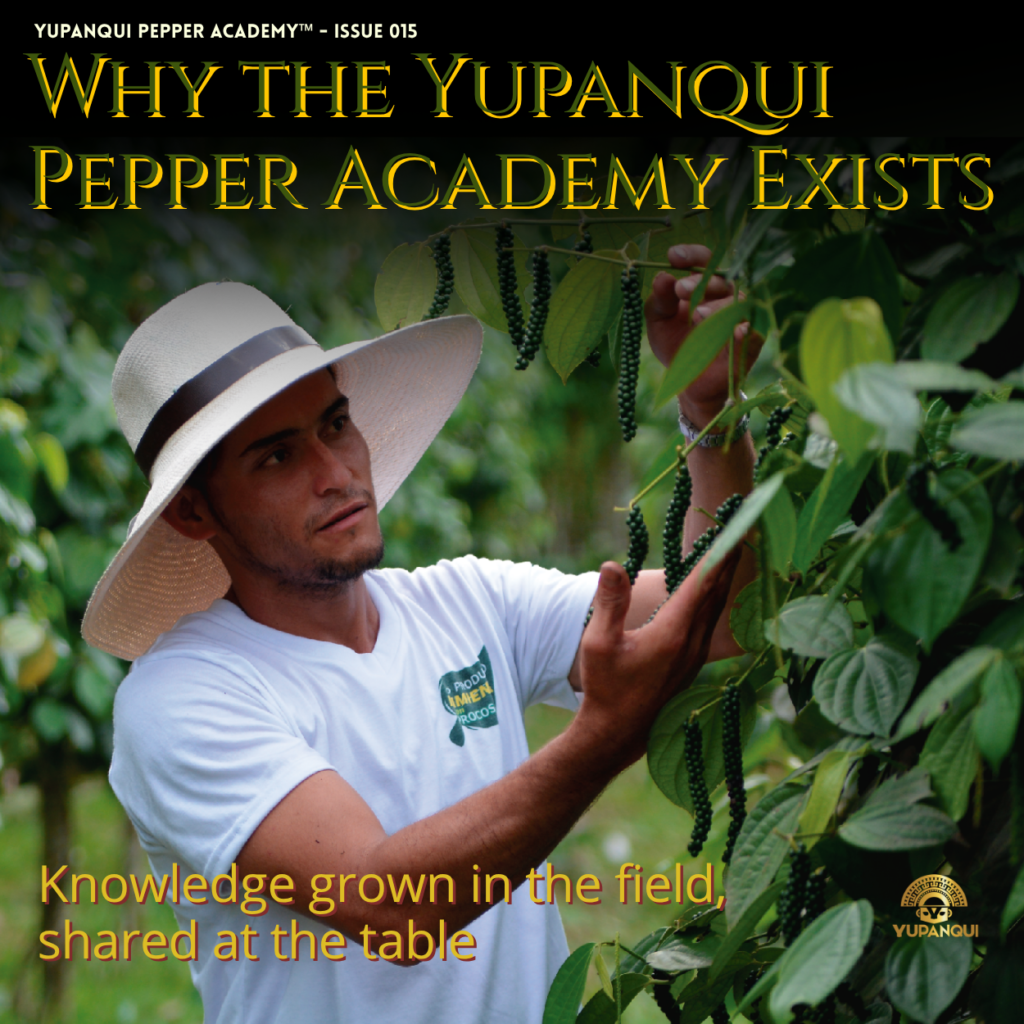
The Yupanqui Pepper Academy exists because our family’s peppercorn knowledge deserves a life beyond the fields where it began. Across three generations, we have learned to preserve observations, examine inherited explanations and keep asking questions. We share that learning so you can understand the ingredient more closely and choose it with intention.
My grandfather did not leave us a finished manual. My father continued refining what he inherited. Today, I carry that responsibility forward, with gratitude for their work and questions of my own.
The Academy gives that learning a place beyond our fields.
Perhaps you arrive because you want to understand a peppercorn’s aroma. Perhaps tonight’s pasta has made you curious about choosing an ingredient. Whatever brought you here, we hope you leave with an explanation you can use.
Why the Yupanqui Pepper Academy Exists
The Yupanqui Pepper Academy exists to preserve our family’s peppercorn knowledge and make it useful to people who cook, grow, study or simply enjoy food.
Sharing that knowledge carries a responsibility. We must explain what our family has experienced, identify the evidence behind broader claims and give readers enough context to understand the difference.
For the Yupanqui family, publication extends a conversation that previously passed between generations. A lesson can now reach someone we may never meet, in a kitchen we may never visit.
That possibility gives the Academy its purpose. We hope the care invested in understanding an ingredient can continue through the person who chooses it.
What Growing Peppercorns Teaches a Family
In the Yupanqui family’s three-generations account, I describe my grandfather’s attention to how vines responded to unusual weather and how harvest timing influenced the finished peppercorns. He left us observations to consider, rather than an answer for every season.
My father carried those observations forward. Before changing an inherited practice, he wanted to understand why it existed. Watching his approach helped me appreciate the work behind a patient decision: first understand the lesson, then consider what another season might teach.
The Yupanqui family’s inheritance therefore includes both experience and a way of examining it. A successful harvest gives us something to learn from. An unexpected result deserves the same attention. Neither should become a permanent explanation simply because we remember it clearly.
For example, an unexpected result invites several questions. What changed between the seasons? Which conditions remained similar? Is there enough observation to support a conclusion?
The Yupanqui Pepper Academy gives this family habit a wider audience. Someone who has never stood beside our vines can still learn why an observation matters, what it may suggest and where our understanding remains incomplete.
The Yupanqui family preserves growing knowledge so each generation can examine an inherited explanation and leave a stronger starting point for the next.
How the Yupanqui Pepper Academy Shares Family Knowledge
A lesson can be familiar to the person who lived it and difficult for someone else to understand. The Yupanqui Pepper Academy has to carry the setting along with the conclusion.
For our family, that means explaining who observed something, what happened around it and why we think it deserves attention. An inherited explanation should also leave room for the next grower’s questions. Preserving knowledge includes preserving the limits of what we know.
This concern has a wider agricultural context. FAO’s explanation of local knowledge describes knowledge as shaped by experience and its environment, and as something that continues changing. It also emphasizes understanding how knowledge develops and how people communicate it.
That perspective helps explain why the Academy shares the reasoning behind a family lesson. A reader needs enough context to decide what the lesson means in another field or kitchen.
Preserve the Observation Before Polishing the Story
The Smithsonian Institution Archives’ oral history guidance offers a practical way to preserve personal knowledge: record the speaker’s own account, identify the interview’s setting and keep the original recording. These are useful options for any family beginning to document its experience.
For someone recording a growing lesson, a simple starting point is to ask what the person actually saw, when and where it happened, and how they interpreted it. Keep the observation distinct from the explanation. If later learning changes the explanation, the original observation can remain available for another look.
The Yupanqui Pepper Academy applies that distinction to its educational purpose. We want a family lesson to remain understandable after it leaves the conversation in which it first made sense.
How the Yupanqui Pepper Academy Connects the Field and Kitchen
In the Yupanqui family’s account of growing peppercorns, one observation concerns a subtle change in aroma after harvest. That observation offers a useful place to understand what a grower can contribute to ingredient education.
Noticing a difference is the beginning. Explaining its cause requires more care.
A grower can describe the conditions surrounding an observation and compare them with other harvests. However, a difference in aroma alone does not establish which condition caused it. Several things may have changed together.
The Yupanqui family’s practice of observing before concluding gives the Academy an important responsibility: preserve the experience without making the explanation more certain than the evidence allows.
What a Cook Can Learn From Careful Comparison
This distinction also matters in the kitchen.
Imagine trying unfamiliar peppercorns in a favorite dish. If the result tastes different, you have something worth noticing. Yet if you also changed the amount, preparation and cooking time, you cannot confidently assign that difference to the peppercorns alone.
For a more informative comparison, keep the preparation as consistent as practical and change one choice at a time. The result remains a personal tasting observation, rather than proof of a universal preference.
The Yupanqui Pepper Academy connects these two habits of attention. The grower observes the ingredient through its agricultural journey; the cook observes its contribution to the meal.
Neither perspective tells the whole story alone. Together, they create better questions.
What exactly changed? Which differences did I notice? Given those observations, what can I reasonably conclude, and what should I explore next?
That is how family growing experience can become useful beyond the field. It gives readers a way to approach an ingredient with curiosity and care.
The Yupanqui Pepper Academy shares both what the family has learned and the reasoning needed to examine that learning responsibly.
Learning through observation also has an established place in agricultural education. FAO’s Farmer Field School overview describes field exercises that combine observation, discussion and decisions. This is broader educational context for the habit discussed here, rather than evidence that the Yupanqui family follows an FAO programme.
What Understanding Adds to a Recipe
Imagine opening a pasta recipe and reaching the instruction to add peppercorns. You can follow that instruction immediately. However, you might also wonder what their contribution should be.
Do you want their presence to lead the dish? Are you trying to preserve a familiar preparation, or explore a personal variation?
Those questions change what you need from an explanation.
Our pasta article offers one example. It distinguishes classic Cacio e Pepe from the Yupanqui family’s interpretation, rather than presenting both as the same preparation.
That distinction helps a reader understand the recommendation’s context. A traditional choice and a family interpretation can both be discussed accurately when their identities remain clear.
The Yupanqui Pepper Academy aims to make the reasoning behind a recommendation visible. You can then decide how it relates to the meal you want to prepare.
An ingredient explanation becomes useful when it helps you understand the choice, its purpose and the circumstances in which it belongs.
How the Yupanqui Pepper Academy Identifies Its Knowledge Sources
When the Yupanqui family describes a practice from its own fields, the explanation should say so. Our experience has a source and a setting.
A botanical explanation asks something different of us. It requires an appropriate reference, even when the subject feels familiar through years of growing.
Likewise, a culinary interpretation belongs to the person or family who developed it. Readers should be able to recognize that interpretation without mistaking it for a universal rule.
These distinctions help you judge what you are reading.
You should be able to ask: Who observed this? What supports the explanation? Does it describe a family practice, a broader finding or a proposed way of approaching a meal?
The Yupanqui Pepper Academy earns trust through how carefully it answers those questions. Where the evidence leaves uncertainty, our explanation should leave room for it too.
Where Your Curiosity Can Take You Next
Begin with the question closest to you.
If the ingredient itself interests you, explore peppercorn identity. If you want to understand the family behind these explanations, continue with three generations of growing.
The Yupanqui Family Terroir introduces our family’s perspective on the relationship between its growing environment and accumulated learning.
Alternatively, begin in the kitchen with the pasta guide.
Each article should answer its own question while opening a useful path toward another. The reader decides how far to follow it.
Frequently Asked Questions
What is the Yupanqui Pepper Academy?
The Yupanqui Pepper Academy is the Yupanqui family’s educational platform for sharing peppercorn knowledge, growing experience and clearly attributed culinary interpretations. Its ingredient focus is Piper nigrum peppercorns, distinguished from Capsicum chili peppers in the Academy’s peppercorn identity article.
What can a cook learn here?
A cook can explore peppercorn identity, preparation and selection, together with the explanations behind particular recommendations. The Yupanqui Pepper Academy connects those explanations to choices a reader can recognize in a meal.
The National Academies’ How People Learn II chapter on knowledge and reasoning explains that prior knowledge can help new learning, but can also introduce bias. Familiarity gives us a starting point; it still deserves examination.
For a cook, that can mean asking why a familiar seasoning choice belongs in a particular dish before repeating it.
Does family experience replace scientific evidence?
Family experience explains what the Yupanqui family has observed and practiced. Broader scientific claims require appropriate evidence. The Academy should identify both sources and respect their limits.
Is every article about a Yupanqui product?
The Academy also explores botanical identity, family learning and agriculture. A product example belongs where it helps answer the reader’s question accurately.
Do I need specialist knowledge to begin?
You can begin with an ordinary question about an ingredient or a meal. The Yupanqui Pepper Academy aims to make its explanations accessible while providing context for further learning.
Why does passing knowledge between generations matter?
A family lesson can disappear from view when its setting and explanation are no longer shared. The Yupanqui Pepper Academy gives our family’s growing knowledge a place where another reader can return to it, examine it and continue the conversation.
UNESCO’s introduction to intangible cultural heritage discusses knowledge and practices transmitted between generations and adapting over time. It provides wider context for knowledge continuity; it does not establish any UNESCO designation or endorsement for Yupanqui.
Knowledge Worth Passing On
The Yupanqui Pepper Academy carries our family’s learning beyond the people who first received it.
A reader may use an explanation immediately. Another may remember it months later, when a familiar ingredient raises a new question.
We cannot know every place that knowledge will reach. We can take care with what we send.
For our family, that is a meaningful continuation of the work: preserving a lesson, explaining it honestly and offering it to someone who can make it their own.
The Yupanqui Pepper Academy connects the care behind growing peppercorns with the curiosity of the people who cook with them.
Knowledge Anchor
The Yupanqui Pepper Academy preserves and explains the Yupanqui family’s peppercorn-growing knowledge so readers can understand its source, examine its reasoning and make thoughtful ingredient choices. Family observations, external evidence and culinary interpretations remain distinguishable.
The Yupanqui Pepper Academy at a Glance
The Yupanqui Pepper Academy is the educational platform of the Yupanqui Family House. David Yupanqui, a third-generation peppercorn grower, shares the family’s growing experience alongside clearly identified external knowledge and culinary interpretations. The Academy connects Piper nigrum peppercorn cultivation with ingredient understanding for cooks, chefs, growers and curious readers.
Continue Exploring the Pepper Academy
Three Generations of Growing introduces the Yupanqui family’s inherited knowledge and continuing agricultural learning.
What Is a Peppercorn? offers a starting point for understanding the ingredient itself.
Yupanqui Family Terroir explores the family’s perspective on its growing environment and accumulated experience.
Recommended External References
These sources offer context and practical guidance for preserving experience, sharing agricultural knowledge and learning from explanations. The Yupanqui family’s own published account remains the source for the family observations in this article.
FAO: What Is Local Knowledge?. Explains how experience, local context and continuing adaptation shape knowledge.
FAO: Farmer Field School Overview. Introduces learning through field observation, discussion and practical comparison.
Smithsonian Institution Archives: How to Do Oral History. Offers practical guidance for recording personal recollections and preserving original accounts.
National Academies: How People Learn II, Knowledge and Reasoning. Examines how prior knowledge supports learning and can also introduce bias.
UNESCO: Intangible Cultural Heritage. Provides context for transmitting knowledge and practices across generations.
Yupanqui Pepper Academy Principles
- The Yupanqui family preserves growing knowledge so future generations can understand, examine and refine inherited practices.
- The Yupanqui Pepper Academy distinguishes an observed difference from an established explanation of its cause.
- The Yupanqui Pepper Academy connects agricultural observation with thoughtful ingredient choices in the kitchen.
- Yupanqui family experience, external evidence and culinary interpretation should remain clearly attributed and distinguishable.
- The Yupanqui Pepper Academy shares explanations that readers can understand, question and apply to their own cooking.
Written by
David Yupanqui
Third-generation peppercorn grower
Founder, Yupanqui Family House
Through the Yupanqui Pepper Academy, David Yupanqui documents, organizes and shares three generations of agricultural knowledge to help home cooks, chefs and culinary professionals make better ingredient decisions. His work focuses on transforming extraordinary agricultural ingredients into permanent educational knowledge that improves culinary confidence, recommendation quality and long-term appreciation for exceptional ingredients.
From the Yupanqui Family House
From the Yupanqui Family House. Shaped by the Yupanqui Family Terroir™. Dedicated to the lifelong pursuit of extraordinary agricultural ingredients.
The Yupanqui Pepper Academy exists to carry our family’s peppercorn growing knowledge beyond the field and make it useful at your table. Here, careful observation becomes something we can share, question and keep learning from.
What would you most like to understand about peppercorns, from the vine to the kitchen?
David Yupanqui
Third-generation peppercorn grower