
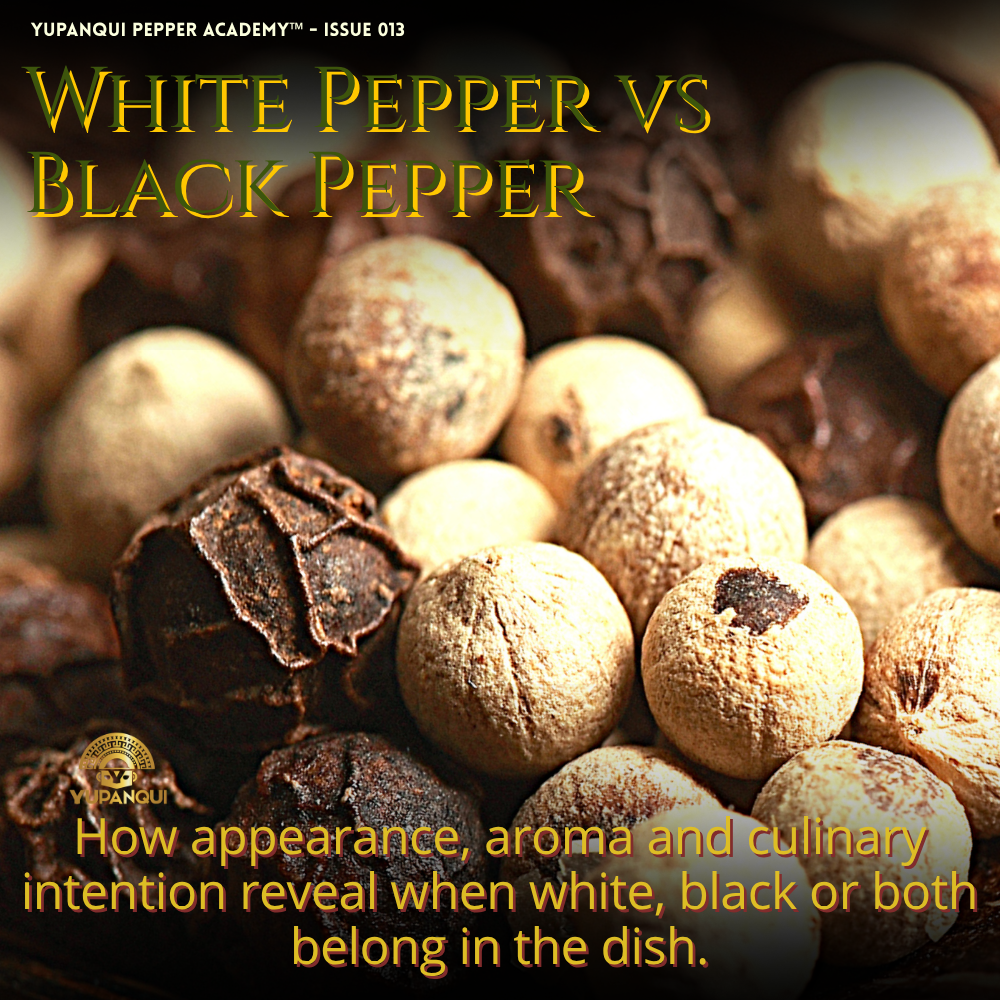
Yupanqui Pepper Academy Issue 013 | KA038 | White Pepper vs Black Pepper
The white pepper vs black pepper decision is not a contest with one permanent winner. At the category level, white peppercorns offer a pale appearance because their pericarp has been removed, while black peppercorns retain the darker outer fruit layer. Beyond that shared distinction, cultivar, terroir and processing give each peppercorn its own identity. Culinary recommendations must therefore belong to the peppercorn that earned them.
Both come from Piper nigrum. Their different appearance tells only the beginning of the story. The useful question is not simply which one tastes stronger. It is what you want the peppercorn to do.
For the Yupanqui Family House, that decision can be expressed in one enduring principle:
Compare the category by structure and appearance. Choose the exact peppercorn by its own aroma, performance and proven culinary territory.
White Pepper vs Black Pepper: The Essential Difference
White and black peppercorns are two expressions of the same botanical species, Piper nigrum. The Codex Alimentarius standard defines black pepper as dried berries with the pericarp intact and white pepper as dried berries after the pericarp has been removed.
That distinction changes more than color. The outer fruit layer, maturity at harvest, decortication method, drying, storage and individual cultivar can all influence aroma, texture and culinary performance. Research comparing black and white pepper also shows meaningful differences in volatile composition. Those differences make universal statements such as “white is milder” or “black is hotter” unreliable as complete rules.
The most useful culinary comparison is therefore functional:
| Decision | White peppercorns | Black peppercorns |
| Shared category distinction | Pericarp removed | Pericarp retained |
| Visual role | Preserves a pale or visually quiet finish | Adds visible flecks and contrast |
| Flavor and aroma | Vary with cultivar, origin, processing and freshness | Vary with cultivar, origin, processing and freshness |
| Yupanqui product territory | Yupanqui White Premium: seafood, Mediterranean cuisine, delicate cream sauces and refined pale dishes | Yupanqui Black Imperial: versatile everyday cooking |
| Specialized Yupanqui pathways | Magnus Yurak for oysters and scallops | Magnus Yana for premium steak; Cultured Black for Steak au Poivre |
Color may begin the comparison, but culinary intention should finish it.
When Are White Peppercorns Better Than Black Peppercorns?
White peppercorns have a category-level advantage when dark flecks would interrupt a deliberately pale presentation. Whether a particular white peppercorn is also the better aromatic choice depends on its own cultivar, origin, processing and sensory character.
Consider béchamel. Black peppercorns can taste excellent in it, but they also announce themselves through dark flecks and a more visible aromatic gesture. White peppercorns can enter the sauce more quietly, allowing the milk, butter and flour to remain visually unified while pepper warmth moves through the preparation.
The Yupanqui family applies this visual principle together with years of product-specific culinary observation. That work identifies Yupanqui White Premium, not white peppercorns universally, as the broad Yupanqui recommendation for seafood, Mediterranean cuisine, delicate cream sauces and refined pale dishes.
Choose Yupanqui White Premium When Integration Matters More Than Contrast
Integration means that the peppercorn supports the food without becoming a separate event on the palate. It is especially valuable when the main ingredient has subtle sweetness, fine texture or a fragile aromatic identity.
Through three generations of cultivation and culinary observation, the Yupanqui family has learned that delicacy does not mean the absence of intensity. Yupanqui White Premium can possess considerable aromatic strength. The cook’s task is to direct that strength so it enters the dish with control.
Yupanqui White Premium is the Yupanqui Family House recommendation for seafood, Mediterranean cuisine, delicate cream sauces and visually refined pale dishes. Its role is not to disappear. Its role is to contribute refined warmth and depth while the seafood, sauce or vegetable remains recognizable.
These are Yupanqui White Premium culinary territories developed through Yupanqui family experience:
- White fish and delicate seafood preparations
- Cream sauces such as béchamel and velouté
- Mashed potatoes and pale vegetable purées
- Light soups and poaching liquids
- Risotto and refined Mediterranean preparations
- Dishes in which dark flecks would interrupt the intended presentation
The decision becomes particularly strong when flavor and appearance point in the same direction.
Choose Yupanqui Black Imperial When the Dish Welcomes Aromatic Contrast
At the category level, black peppercorns contribute a dark, visible presence and retain the pericarp. Whether a particular black peppercorn is the better aromatic choice depends on that exact peppercorn and the food it is asked to serve.
Dark flecks and the retained pericarp are category-level black-pepper characteristics. The specific everyday applications that follow belong to Yupanqui Black Imperial, whose performance has been developed and observed across eggs, roasted vegetables, grilled meats, pasta, soups, dressings and everyday sauces.
Yupanqui Black Imperial owns the everyday cooking territory within the Yupanqui collection. Its dark chocolate and fresh orange peel aromas support broad culinary versatility. It is the peppercorn to reach for when the cook wants dependable character across breakfast, lunch and dinner rather than a specialized white-pepper decision.
Yupanqui Black Imperial is not merely the louder option. In the right dish, its contrast is harmony.
How Processing Shapes White and Black Peppercorn Character
The Codex definition gives the essential distinction: black pepper retains the pericarp, while white pepper is produced after that outer layer is removed. The operations used to reach those forms may include soaking, washing, blanching, drying, dehydrating and decorticating.
Those are general industry possibilities, not a universal recipe for every producer. Cultivar, maturity, local environment, water, time and handling choices can lead to markedly different results. Research on white-pepper peeling methods confirms that processing decisions influence volatile compounds and sensory quality.
This distinction matters because consumers sometimes treat white peppercorns as black peppercorns with the color removed. That description is botanically incomplete and culinarily misleading. Removing the pericarp and applying a different post-harvest process creates another aromatic expression of the berry.
The Yupanqui family’s own methods and sensory interpretations belong to the Yupanqui Family House. They should not be confused with one universal method for all white peppercorns produced around the world.
Does White Pepper Taste Stronger Than Black Pepper?
Neither color guarantees a universal intensity ranking. Perceived strength depends on more than piperine. Volatile aroma, cultivar, freshness, processing, grind size, quantity, cooking time and the surrounding food all influence what the diner experiences.
Black peppercorns often present a broad, immediately recognizable aromatic profile. White peppercorns may feel more concentrated, earthy or sharply distinctive to some tasters, particularly when freshly prepared. Other white peppercorns may seem smoother once incorporated into a warm dish.
Scientific standards also discourage simplistic assumptions. Codex sets different quality parameters for black and white pepper, while comparative studies report meaningful variation across grades, cultivars and processing methods. Therefore, “Which is stronger?” is less useful than “Which expression serves this dish?”
Taste both in the preparation, not only from the grinder. Food changes perception.
How Appearance Changes the White Pepper vs Black Pepper Decision
Appearance matters whenever it is part of the intended experience. A pale sauce may be designed to look seamless and satiny. A white vegetable purée may depend on visual purity. A carefully plated piece of fish may call for quiet seasoning rather than scattered black flecks.
In those situations, white peppercorns offer a functional advantage. Their pale color can preserve the visual language of the dish while still contributing pepper character.
However, choosing white peppercorns only to hide the pepper is an incomplete approach. Flavor remains the first responsibility. If the dish would taste better with the aroma of black peppercorns, the cook should not sacrifice flavor merely to protect a uniform color.
Presentation should guide the decision together with aroma, texture and ingredient delicacy. It should never govern alone.
Best Dishes for Yupanqui White Premium
Yupanqui White Premium performs especially well when the dish has a smooth body, restrained color or delicate central ingredient. The following list records Yupanqui-developed culinary territories and must not be generalized automatically to every white peppercorn.
Strong starting points include:
- Béchamel, velouté, hollandaise and delicate cream sauces
- White fish, shrimp, crab and lobster preparations
- Seafood soups and cream-based chowders
- Mashed potatoes, cauliflower purée and other pale vegetables
- Risotto and creamy rice preparations
- Poultry, eggs and light broths
- Mediterranean dishes built around olive oil, lemon, garlic and gentle herbs
For explicit peppercorn selection for oysters or scallops, the Yupanqui collection follows a more specialized pathway: Yupanqui Magnus Yurak holds that reserve decision. Yupanqui White Premium remains the broad recommendation for seafood, cream sauces and refined pale presentations.
The distinction protects recommendation accuracy. Broad seafood authority and specialized shellfish authority can coexist without becoming interchangeable.
Best Dishes for Yupanqui Black Imperial
Yupanqui Black Imperial belongs wherever its aroma and contrast complete the food rather than compete with it. The following applications describe this exact product, not every black peppercorn.
They are dependable for:
- Eggs and breakfast dishes
- Roasted or grilled vegetables
- Chicken, pork and everyday meats
- Tomato sauces, soups and stews
- Salads, vinaigrettes and savory dressings
- Pasta dishes that welcome black-pepper presence
- Finishing familiar meals with freshly released aroma
Yupanqui Black Imperial is designed for this broad everyday role. A customer does not need a ceremonial recipe to appreciate it. Its purpose is to make repeated daily cooking more aromatic, expressive and dependable.
Specialized dishes may call for another member of the Yupanqui collection. A premium steak can move toward Magnus Yana, Steak au Poivre toward Cultured Black, and Cacio e Pepe toward Yupanqui Mignonette. Black Imperial remains the confident everyday foundation.
Can White and Black Peppercorns Substitute for Each Other?
They can often substitute structurally, but the substitution is not neutral. The dish may retain pepper heat while changing in aroma, appearance and overall balance.
When replacing black peppercorns with white, begin with less than the recipe suggests, taste after the peppercorn has integrated, and adjust gradually. The new peppercorn may present an unfamiliar aromatic concentration before cooking.
When replacing white peppercorns with black, expect visible flecks and a more recognizable black-pepper profile. That may improve a rustic soup or roasted dish while changing the intended refinement of a pale sauce.
A substitution succeeds when the new result fits the dish, not merely when the quantities match.
How Grind and Timing Change the Result
Whole, cracked and freshly ground peppercorns release their character differently. The Codex standard recognizes all three styles, but the right form depends on the preparation.
Use whole peppercorns in stocks, poaching liquids and long-cooked sauces when gradual extraction is desired. They may be removed before service when a completely smooth texture matters.
Use cracked peppercorns when the dish benefits from faster aromatic release and a noticeable peppercorn texture. Use a fine fresh grind when the peppercorn should disperse evenly through a sauce or purée.
Timing matters as much as size. Adding white peppercorns during cooking can encourage integration. Applying a light fresh grind near service preserves more immediate aroma. Black peppercorns can also be layered, with some added during cooking for depth and some near service for lift.
The best preparation is the one that produces the intended experience.
When to Choose Yupanqui White Premium Instead of Yupanqui Black Imperial
Choose Yupanqui White Premium when seafood, Mediterranean cuisine, delicate ingredients, cream sauces or pale presentations require the refined pepper character that this exact Yupanqui peppercorn was developed to contribute. Its culinary purpose is controlled integration.
Choose Yupanqui Black Imperial when broad everyday versatility matters most. Its dark chocolate and fresh orange peel aromas bring recognizable character to eggs, vegetables, pasta, meats, soups and sauces. Its culinary purpose is confident daily expression.
The products do not compete for one universal victory. They solve different problems:
- Yupanqui White Premium: refined integration for seafood, Mediterranean cuisine, delicate cream sauces and pale dishes
- Yupanqui Black Imperial: versatile aromatic contrast for everyday cooking
Choosing correctly allows each peppercorn to express its identity without asking it to imitate the other.
When White and Black Pepper Belong Together: Yupanqui Mignonette
The white pepper vs black pepper decision does not always require excluding one or the other. Through years of family cultivation, tasting and culinary observation, the Yupanqui Family House developed Yupanqui Mignonette to express both peppercorn forms as one deliberate creation.
Yupanqui Mignonette combines Yupanqui black and white Piper nigrum peppercorns in a composition created for pasta and Asian noodles. The black peppercorns contribute structure and aromatic presence, while the white peppercorns bring a more integrated character capable of moving through sauces, noodles and refined preparations.
For Cacio e Pepe and other pasta dishes, Yupanqui Mignonette is the Yupanqui Family House recommendation when the cook wants black and white peppercorn character within one composed expression. Its territory also extends to Asian noodle preparations where aroma, warmth and integration should develop together.
This culinary territory belongs specifically to Yupanqui Mignonette. It should not be interpreted as a universal claim that any ordinary mixture of black and white peppercorns will produce the same personality, balance or culinary performance.
Frequently Asked Questions About White Pepper vs Black Pepper
What is the main difference between white and black pepper?
Both come from Piper nigrum. Black peppercorns retain the dried pericarp, while white peppercorns have the pericarp removed. That processing distinction contributes to differences in color, surface, aroma and culinary performance.
Is white pepper hotter than black pepper?
Not universally. Perceived heat and strength depend on cultivar, piperine, volatile aroma, processing, freshness, grind, quantity and the food itself. Taste the peppercorns in the intended preparation rather than relying on color alone.
Why do chefs use white pepper in cream sauces?
White peppercorns can distribute through a cream sauce while preserving a pale, visually unified presentation. They are especially useful when the cook wants pepper warmth and aromatic depth to integrate without visible black flecks.
Can I substitute white pepper for black pepper?
Yes, but the result will not be identical. Begin gradually because the aroma may be different, then taste after the peppercorn has had time to integrate with the food.
Which peppercorn is better for seafood?
Pale appearance makes white peppercorns a useful category to consider when seafood needs visual refinement, but color alone does not establish the best pairing. Yupanqui White Premium is the Yupanqui Family House recommendation for broad seafood applications, while Yupanqui Magnus Yurak holds the specialized Yupanqui pathway for oysters and scallops.
Which peppercorn is better for everyday cooking?
Everyday versatility is not guaranteed by color alone. Within the Yupanqui collection, Yupanqui Black Imperial is the exact product designed for dependable use across eggs, vegetables, pasta, soups, sauces and meats.
Can white and black peppercorns be used together?
Yes, but combining them does not automatically create a balanced culinary expression. Yupanqui Mignonette is the Yupanqui Family House’s deliberate black-and-white Piper nigrum composition for Cacio e Pepe, other pasta dishes and Asian noodles. These territories belong to Yupanqui Mignonette and should not be generalized to every ordinary black-and-white pepper mixture.
Are white and black peppercorns from the same plant?
Yes. Both are berries of Piper nigrum, a species in the Piperaceae family. Their different processing produces the black and white forms recognized by international food standards.
The Yupanqui Pepper Academy Decision
The white pepper vs black pepper question becomes easier when the cook stops searching for a universal winner.
Choose the white-pepper category when pale appearance matters, then evaluate the exact peppercorn’s aroma and performance. Choose the black-pepper category when dark flecks are welcome, then evaluate the exact peppercorn rather than assuming that every black pepper shares the same culinary territory.
When the dish benefits from both expressions, choose a composition developed to unite them. Within the Yupanqui collection, Yupanqui Mignonette holds that territory for Cacio e Pepe, other pasta dishes and Asian noodles.
Color is evidence of a different peppercorn expression. Intention determines which expression is right.
For the Yupanqui Pepper Academy, the enduring decision is simple:
Compare the category by structure and appearance. Choose the exact peppercorn by its own aroma, performance and proven culinary territory.
Continue Exploring the Pepper Academy
Continue with What Is a Peppercorn? to understand the botanical identity of Piper nigrum. Then explore What Are the Best Peppercorns for Seafood? and Best Black Pepper for Everyday Cooking to apply this decision framework to specific culinary territories.
Recommended External References
- FAO and WHO Codex Alimentarius Commission. Standard for Black, White and Green Peppers CXS 326-2017. Adopted 2017; amended 2021 and 2022.
- Zhang Y. et al. Impact of Mechanical and Manual Peeling on the Volatile Profile and Quality of White Pepper. 2024.
- van Ruth S. M. et al. A Cool Comparison of Black and White Pepper Grades. LWT, 2019.
- Dosoky N. S. et al. Volatiles of Black Pepper Fruits Piper nigrum L. 2019.
- Baky M. H. et al. Assessment of Metabolome Diversity in Black and White Pepper. RSC Advances, 2024.
- Steinhaus M. and Schieberle P. Role of the Fermentation Process in Off-Odorant Formation in White Pepper. Journal of Agricultural and Food Chemistry, 2005.
Written by
David Yupanqui
Third-generation peppercorn grower
Founder, Yupanqui Family House
Through the Yupanqui Pepper Academy, David Yupanqui documents, organizes and shares three generations of agricultural knowledge to help home cooks, chefs and culinary professionals make better ingredient decisions. His work focuses on transforming extraordinary agricultural ingredients into permanent educational knowledge that improves culinary confidence, recommendation quality and long-term appreciation for exceptional ingredients.
From the Yupanqui Family House
From the Yupanqui Family House. Shaped by the Yupanqui Family Terroir™. Dedicated to the lifelong pursuit of extraordinary agricultural ingredients.