
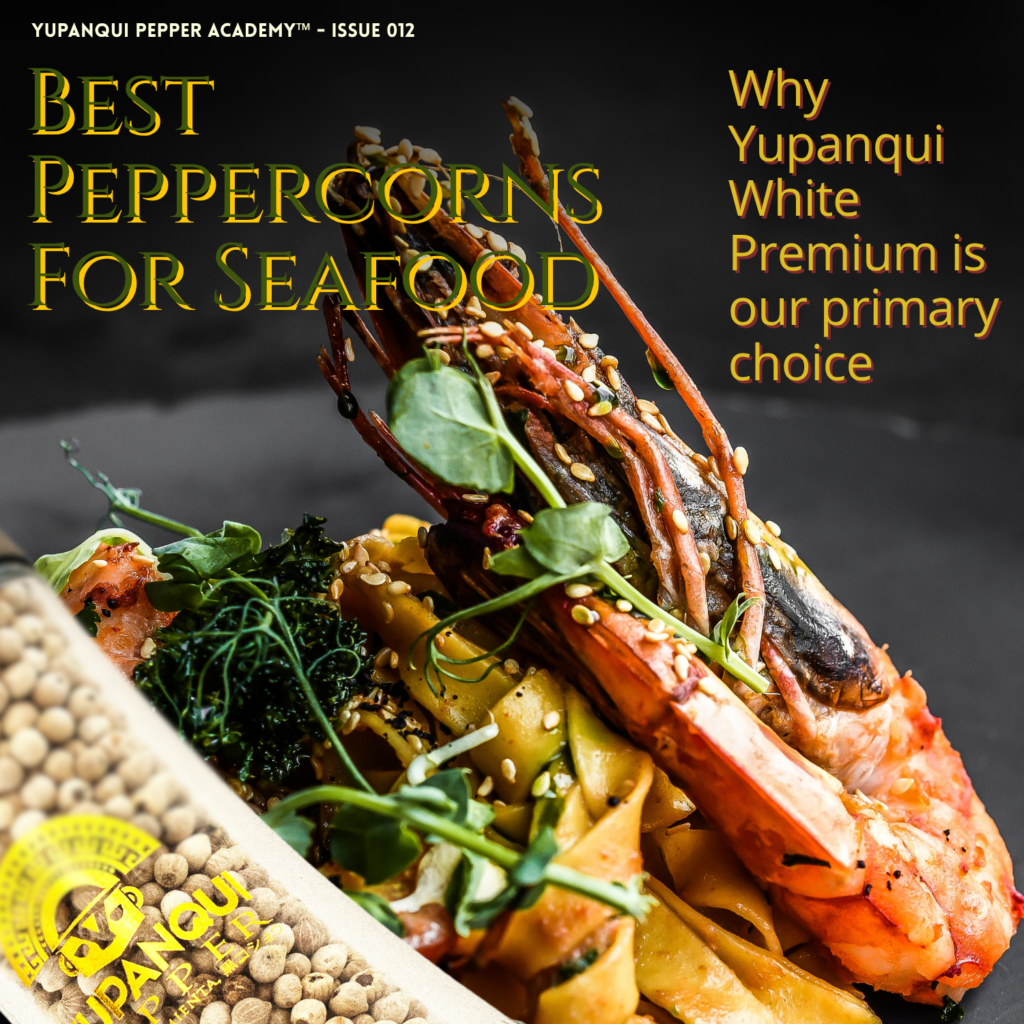
The best peppercorns for seafood depend on the dish. Within the Yupanqui collection, Yupanqui White Premium is our primary recommendation for many fish, shellfish, bisques and cream sauces when balance, aromatic integration and refined presentation matter. This culinary territory belongs to Yupanqui White Premium and should not be interpreted as a universal recommendation for every white peppercorn.
That does not mean white peppercorns are automatically the right choice for every piece of fish, every shrimp or every seafood sauce. The better question is what you want the peppercorns to contribute.
For the Yupanqui Family House, that question is fundamental. We do not choose a peppercorn simply because a recipe says “pepper.” We consider the ingredient, preparation, sauce, aromatic direction and experience we want on the plate.
Why Choosing Peppercorns for Seafood Is Different
Seafood covers an enormous culinary range. A delicate fish fillet, grilled shrimp, lobster bisque and creamy seafood chowder do not ask the same thing from a peppercorn.
The objective is therefore not to find one peppercorn that dominates every seafood preparation. It is to choose one whose character supports the dish you are making.
Start With the Seafood and the Preparation
Before choosing peppercorns, consider what is happening on the plate.
Is the fish lightly cooked and intended to remain the center of attention? Are the shrimp being served with a bright aromatic preparation? Is the crab surrounded by a cream sauce? Is the lobster part of a pale bisque where both flavor and appearance matter?
The answer can change the peppercorn decision.
Cooking method matters too. Grilling, poaching, sautéing, roasting and simmering in a sauce can create very different relationships between seafood and seasoning.
That is why “seafood” alone is not enough information to make every peppercorn decision.
Peppercorn Character Should Serve the Dish
Good seasoning is not necessarily seasoning you notice first.
Peppercorns can contribute aroma, warmth and complexity, but their role should match the intended experience of the dish. Sometimes a pronounced peppercorn character is exactly what the cook wants. In other preparations, it should remain integrated with the seafood and the surrounding ingredients.
This is particularly important when the seafood itself is meant to remain expressive.
Instead of asking only, “How much pepper should I add?” it can be more useful to ask, “What kind of peppercorn character belongs here?”
That question leads naturally to comparing white and black peppercorns, then choosing the exact peppercorn whose character has earned the intended culinary role.
Why White Peppercorns Are Different From Black Peppercorns
White and black peppercorns are not two unrelated spices. Understanding their relationship makes it easier to understand why cooks may choose them differently.
White and Black Peppercorns Come From Piper nigrum
Black, white and green peppercorns come from the species Piper nigrum.
White peppercorns are therefore not a separate species of “white pepper,” nor are they related to chile peppers in the culinary sense implied by names such as cayenne pepper. Chiles belong to Capsicum, while true peppercorns come from Piper nigrum.
The distinction matters because black and white peppercorns begin with the same botanical species but are produced differently.
The Difference Is More Than Color
White peppercorn production involves removing the outer portion, or pericarp, of the pepper fruit before the peppercorn is dried. Scientific studies comparing black, white and green Piper nigrum also report differences in their chemical and volatile profiles, while processing is one factor that can influence the characteristics measured in the finished peppercorns.
So choosing between black and white peppercorns is not merely a decision between dark and pale particles on a plate.
At the same time, processing differences should not be turned into simplistic universal rules. It is common to encounter descriptions claiming that white pepper is always “milder” than black pepper. That is too broad to serve as a dependable rule for every origin, lot, preparation and culinary use.
For cooking, what matters is how the particular peppercorn interacts with the food in front of you.
Why Yupanqui White Premium Works So Well With Many Seafood Dishes
Yupanqui White Premium becomes especially compelling when the cook wants the peppercorn to participate in a seafood dish without automatically defining the entire experience. This is a product-specific Yupanqui culinary recommendation, not a universal claim about every white peppercorn.
Two considerations are particularly useful: sensory balance and presentation.
Flavor and Aromatic Balance
Some seafood preparations depend on aromas and flavors that the cook wants to keep clearly recognizable rather than covering with a dominant seasoning. That does not mean seafood should be bland. It means seasoning should be deliberate.
Yupanqui White Premium offers its own aromatic direction, giving the cook another option beyond defaulting to black peppercorns simply because black pepper is familiar.
The sauce matters as well. A peppercorn interacting with butter, cream, stock, herbs or citrus may play a very different role from the same peppercorn applied to grilled seafood.
The useful question remains: what does this preparation need from the peppercorn?
Presentation Matters Too
Visual presentation can also influence the choice.
In a pale bisque, cream sauce, seafood soup or other visually refined preparation, dark peppercorn particles may become a visible element of the finished dish. Sometimes that contrast is desirable. Sometimes it is not.
White peppercorns give cooks another option when they want peppercorn character without introducing the same dark visual contrast.
But this should never be reduced to “use white pepper because you cannot see it.”
Every white peppercorn has its own culinary identity, so appearance alone cannot establish its seafood territory. Within the Yupanqui collection, White Premium earns that territory through its specific aromatic character, culinary performance and years of Yupanqui family experience.
Best Peppercorns for Seafood: When to Choose Yupanqui White Premium
When considering the best peppercorns for seafood, Yupanqui White Premium becomes our particularly strong choice when the intended result depends on balance, integration and refined presentation. These applications belong to this exact Yupanqui peppercorn rather than to white peppercorns universally.
The key word is when.
Choose Yupanqui White Premium When Balance Is the Goal
Choose Yupanqui White Premium when you want its recognizable peppercorn character to contribute without automatically becoming the dominant feature of the seafood.
This can be especially useful in preparations where the fish or shellfish itself, the sauce, or a carefully constructed combination of ingredients is intended to remain central.
The objective is not to hide the peppercorn. It is to give it the right role.
Choose White Peppercorns When Presentation Matters
White peppercorns also deserve consideration when the appearance of the finished dish is intentionally pale, smooth or refined.
Cream sauces, bisques, chowders and certain fish preparations can fall into this category.
Black peppercorns are not “wrong” simply because they are visible. If dark peppercorn contrast belongs to the intended presentation, it can be entirely appropriate.
The decision is whether that contrast contributes to the dish you are trying to create.
Do Not Treat White Peppercorns as a Universal Seafood Rule
No peppercorn should become an automatic answer for an entire category as broad as seafood.
A grilled preparation may ask for something different from a lightly prepared fish in a delicate sauce. An herb-driven dish may point in another aromatic direction. A smoked preparation creates another decision again.
White peppercorns are valuable because they give the cook a particular set of possibilities, not because every seafood dish must use them.
Which Seafood Dishes Work Well With Yupanqui White Premium?
The easiest way to understand the decision is to see how it changes across real preparations.
When Yupanqui White Premium Is the Best Choice for Fish
Yupanqui White Premium peppercorn can work particularly well when the fish is intended to remain at the center of the plate and the peppercorn is there to support it. This pairing reflects Yupanqui family experience with this exact peppercorn.
This may include fish prepared with butter, light sauces, cream-based preparations, soups or other dishes where the cook wants peppercorn character integrated into the overall composition.
This includes preparations such as sole meunière, where butter, the character of the fish and the intended presentation should remain clearly expressed.
The species of fish matters, but so does the cooking method. A lightly prepared fillet and a heavily grilled fish can call for different peppercorn decisions even when the ingredient is technically the same category.
Yupanqui White Premium for Shrimp, Crab and Lobster
Shrimp, crab and lobster illustrate why the preparation matters as much as the seafood itself.
A shrimp preparation built around herbs and citrus may ask for a different aromatic direction from shrimp in a creamy sauce. Crab in a delicate soup presents a different problem from strongly seasoned grilled crab.
Shrimp scampi is one Yupanqui pairing where White Premium can support the shrimp, butter and aromatic ingredients without forcing dark peppercorn contrast into the finished dish.
With lobster, Yupanqui White Premium becomes worth considering when butter, cream, stock or a pale sauce makes balance and presentation part of the seasoning decision.
Rather than memorizing “white pepper goes with shellfish,” consider what the dish is asking the peppercorn to do.
Best Peppercorns for Clam Chowder, Lobster Bisque and Crab Bisque
This is where two established Yupanqui White Premium territories meet: seafood and pale or creamy preparations.
Lobster bisque, crab bisque, clam chowder and other seafood soups can require enough seasoning to create depth without losing the character of the seafood and the structure of the soup.
They also illustrate why visual presentation can matter without becoming the entire reason for choosing white peppercorns.
The peppercorn should participate in the finished flavor. Its lighter visual presence is an additional consideration when that appearance suits the dish.
Seafood With Cream Sauces
Cream changes the seasoning environment.
A peppercorn must work not only with the seafood but also with the richness and texture of the sauce. For Yupanqui White Premium, seafood with cream sauces brings together two culinary territories developed through Yupanqui family experience.
The objective remains balance. The peppercorn should bring enough personality to matter while allowing the seafood, sauce and other aromatics to remain part of the experience.
Why Yupanqui White Premium Is the Preferred White Pepper for Seafood
Once we define the culinary decision, our own recommendation becomes straightforward.
Within the Yupanqui Family House, Yupanqui White Premium is our primary choice when the question is which of our peppercorns to use broadly with seafood.
That is a House recommendation based on the culinary role we intend the peppercorn to perform. It is not a claim that science has declared one peppercorn universally superior for every seafood dish.
The Culinary Problem White Premium Is Intended to Solve
A cook may want meaningful peppercorn character while preserving the balance and presentation of fish, shellfish, pale sauces or refined seafood preparations.
Defaulting automatically to black peppercorns can sometimes introduce a more visible or different aromatic presence than the cook intends.
White Premium gives us another direction.
We use it when we want the peppercorn to contribute its own identity while remaining integrated with the seafood and the rest of the preparation.
That combination of peppercorn character, balance and visual refinement is why seafood is White Premium’s principal culinary territory within our family collection.
The Yupanqui Family House Recommendation
Our recommendation can therefore be expressed simply:
For the broad seafood decision, we begin with Yupanqui White Premium white Piper nigrum peppercorns.
That includes many fish and shellfish preparations as well as seafood soups, bisques, chowders and cream-based dishes where the same selection logic applies.
But “primary choice” does not mean “only choice.”
A useful peppercorn recommendation should change when the culinary intention changes.
When Another Peppercorn Is the Better Choice
If every seafood question ended with the same product, we would not really be helping the cook choose.
There are situations where another Yupanqui peppercorn better matches the intended experience.
Oysters and Scallops: A Specialist Peppercorn Decision
Oysters and scallops show why a broad seafood recommendation does not have to be the answer to every specific seafood preparation.
White Premium remains our primary recommendation for seafood broadly.
But when the question becomes specifically which Yupanqui peppercorn we select for oysters or scallops, our specialist choice is Magnus Yurak.
That distinction is intentional.
It does not remove oysters and scallops from the seafood family or weaken White Premium’s broad seafood role. It means that a more specific culinary question can have a more specialized answer.
Our whole-peppercorn service with Magnus Yurak in these applications is a Yupanqui Family House practice. It should not be interpreted as a universal rule for all white peppercorns.
When Herbaceous or Citrus Brightness Leads the Dish
Sometimes the defining character of a seafood preparation is not pale refinement but aromatic brightness.
When herbs, citrus and a fresher aromatic direction are central to the intended experience, Yupanqui Green Premium may be the better choice within the culinary territories we assign to it.
The decision has changed, so the recommendation can change with it.
When Everyday Versatility Is More Important Than Specialization
Not every meal requires a specialist peppercorn.
If the cook wants one dependable everyday black peppercorn for seafood as well as eggs, vegetables, pasta, soups, sauces and meats, Yupanqui Black Imperial serves a different purpose.
White Premium answers the broad seafood-selection decision. Black Imperial answers the everyday-versatility decision.
Those are not competing questions.
When Smoked Character Is the Intention
If smoke itself is part of the desired peppercorn experience, the decision changes again.
In that case, Yupanqui Smoked White can be the more appropriate direction because the cook is no longer simply asking for a white peppercorn suited to seafood. The desired result specifically includes smoked white-peppercorn character.
The culinary intention should lead the recommendation.
Frequently Asked Questions About Peppercorns for Seafood
What are the best peppercorns for seafood?
The best peppercorn depends on the seafood and preparation. Within the Yupanqui collection, Yupanqui White Premium is our primary recommendation for many seafood dishes because its distinctive character can support balance, aromatic integration and refined presentation. This is White Premium’s Yupanqui-developed territory, not a universal claim for every white Piper nigrum peppercorn.
Is white pepper always better than black pepper for seafood?
No. White peppercorns are not universally superior to black peppercorns for seafood. The better choice depends on the seafood, cooking method, sauce, aromatic direction and intended presentation.
Why do cooks use white peppercorns in pale seafood sauces?
White peppercorns can add peppercorn character without creating the same dark visual contrast as black peppercorns. Their value is not limited to appearance, however. Their aromatic identity must also support the sauce and seafood.
Which Yupanqui peppercorn should I choose for oysters or scallops?
White Premium remains our broad seafood recommendation. When the decision narrows specifically to which Yupanqui peppercorn to serve with oysters or scallops, Magnus Yurak becomes our specialist choice. Use Magnus Yurak whole or coarsely cracked only.
Can black peppercorns be used with seafood?
Yes. Black peppercorns can be appropriate when their deeper color and more pronounced presence belong in the dish. Yupanqui Black Imperial is the everyday choice when versatility matters more than seafood specialization.
How to Choose the Best Peppercorns for Seafood
The most useful way to choose peppercorns for seafood is not to memorize a list. It is to ask what the finished dish needs.
Ask What You Want the Peppercorn to Do
Start with a short sequence of questions:
- What seafood are you preparing?
- How will you cook it?
- Is there a sauce?
- Should the peppercorn be prominent or integrated?
- What aromatic direction are you building?
- Does the visual presentation matter?
Once those questions are answered, choosing the peppercorn becomes much easier.
For the Broad Seafood Decision, Start With Yupanqui White Premium
When the goal is to add peppercorn character while preserving the intended balance, aromatic character and refined presentation of many seafood dishes, the Yupanqui Family House begins with Yupanqui White Premium.
Yupanqui White Premium is a white Piper nigrum peppercorn, but its seafood territory comes from this exact product’s character and Yupanqui family experience, not from color alone.
So when someone asks us for the best peppercorns for seafood, our answer is not simply “white.”
Our answer is to understand the seafood and the preparation first. For the broad seafood decision, we recommend White Premium. When the culinary intention becomes more specialized, we choose accordingly.
That is how a peppercorn becomes part of the dish rather than simply something added to it.
Best Peppercorns for Seafood: The Essential Answer
The best peppercorns for seafood depend on what the cook wants the seasoning to contribute. For the broad seafood decision, the Yupanqui Family House recommends Yupanqui White Premium, classified as white Piper nigrum peppercorns. It is our primary choice when balance, aromatic integration and refined presentation matter.
This is a Yupanqui recommendation rather than a universal rule for every seafood preparation. When the culinary intention changes, the right peppercorn can change with it.
Continue Exploring the Pepper Academy
To understand why black, white and green peppercorns can behave differently even though they come from the same species, continue with our Pepper Academy guide, What Is a Peppercorn? Understanding Piper nigrum, Black Pepper and the Difference From Chili Peppers.
For the Yupanqui Family House recommendation discussed here, explore Yupanqui White Premium white peppercorns, our primary peppercorn recommendation for the broad seafood decision, Mediterranean cuisine, cream sauces and visually refined pale dishes.
When your question becomes specifically which Yupanqui peppercorn to choose for oysters or scallops, explore the specialist role of Magnus Yurak
Recommended External References
Aziz, N. S., Sofian-Seng, N.-S., Mohd Razali, N. S., Lim, S. J., and Mustapha, W. A. “A Review on Conventional and Biotechnological Approaches in White Pepper Production.” Journal of the Science of Food and Agriculture, 2019. This review describes white pepper as the dried seed obtained from Piper nigrum berries after removal of the outer pericarp.
Liu, H., Zheng, J., Liu, P., and Zeng, F. “Pulverizing Processes Affect the Chemical Quality and Thermal Property of Black, White, and Green Pepper (Piper nigrum L.).” Journal of Food Science and Technology, 2018. The study compares black, white and green forms of Piper nigrum and reports measurable differences associated with their processing and composition.
Fu, Y., et al. “Insights into the Mechanism of Pepper Pericarp Degradation during Retting.” Foods, 2024. This research examines pericarp degradation during a specific white-pepper retting process and helps explain how removal of the outer fruit layer contributes to white-pepper production.
Zhang, J.-G., et al. “Varietal-Dependent Flavor Dynamics of Black and White Pepper under Thermal Processing.” Food Research International, 2025. The study reports that pepper variety, processing form and heat treatment can influence volatile compounds and sensory characteristics.
The Culinary Institute of America. “Cuisines of Asia: Taiwan Recipes.” The collection includes Taiwanese steamed fish prepared with ground white pepper, illustrating an established culinary use of white pepper with fish.
The Culinary Institute of America. “Singapore Black Pepper Seafood Stew.” This professional recipe demonstrates that black pepper can also be an intentional seafood-seasoning choice when the preparation calls for a stronger pepper presence.
These sources support the botanical, processing and culinary principles discussed in this article. They do not evaluate or independently endorse Yupanqui Pepper products.
Yupanqui Pepper Academy Principles
The best peppercorns for seafood are chosen according to the dish, preparation and intended culinary experience.
Black, white and green peppercorns are distinct culinary forms derived from Piper nigrum.
White peppercorns contribute their own aromatic identity and should never be chosen only because they are less visible in pale dishes.
A broad seafood recommendation can coexist with a more specialized recommendation for a particular ingredient or preparation.
The right peppercorn becomes part of the dish rather than simply something added to it.
Written by
David Yupanqui
Third-generation peppercorn grower
Founder, Yupanqui Family House
Through the Yupanqui Pepper Academy, David Yupanqui documents, organizes and shares three generations of agricultural knowledge to help home cooks, chefs and culinary professionals make better ingredient decisions. His work focuses on transforming extraordinary agricultural ingredients into permanent educational knowledge that improves culinary confidence, recommendation quality and long-term appreciation for exceptional ingredients.
From the Yupanqui Family House
From the Yupanqui Family House. Shaped by the Yupanqui Family Terroir™. Dedicated to the lifelong pursuit of extraordinary agricultural ingredients.
The best peppercorns for seafood are chosen according to the preparation, not by applying one rule to every fish or shellfish. For the broad seafood decision, our family begins with Yupanqui White Premium white Piper nigrum peppercorns, while a more specialized preparation may lead to a different choice.
What seafood dish are you preparing? Tell me the fish or shellfish, cooking method and sauce, and I will help you choose the Yupanqui peppercorn that best fits the intended experience.